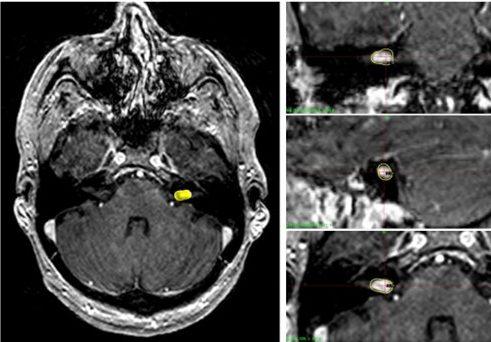
From time to time on the Neurosurgery Blog, you will see us cross-posting or linking to items from other places when we believe they hit the mark on an issue. We wanted to bring attention to a recent publication in Neurosurgery, the official journal of the Congress of Neurological Surgeons, which provides multimedia, prompt publication of scientific articles on clinical or experimental surgery topics important for the brain, spine, and peripheral nerves, reviews, and other information of interest to readers across the world. The article, Vestibular Schwannoma Koos Grade I International Study of Active Surveillance Versus Stereotactic Radiosurgery: The VISAS-K1 Study, is published as part of Neurosurgery’s High-Impact Manuscript Service (HIMS).
Published online ahead of print on Nov. 6 and expected to appear in the January 2025 issue of Neurosurgery, the article indicates that as primary care for Koos grade I vestibular schwannomas, stereotactic radiosurgery (SRS) is superior to observation with regard to tumor control and preservation of neurologic function.
“Our strategy for managing patients with Koos grade I vestibular schwannomas has traditionally involved treating larger tumors and those causing symptoms with SRS, while smaller, asymptomatic tumors were observed,” reports Jason P. Sheehan, MD, PhD, and his colleagues.
According to the Wolters Kluwer press release, “[T]he findings from this study, along with other published studies, indicate that even asymptomatic patients with smaller tumors may benefit from SRS over observation at the time of diagnosis.” SRS afforded superior tumor control and significantly reduced neurological impairment compared to observation in vestibular schwannoma Koos grade I patients.
To read the full Neurosurgery article, click here.
Editor’s Note: We hope you will share what you learn from our posts. We invite you to join the conversation on X by following @Neurosurgery and @NeurosurgeryCNS and using the hashtag #neurosurgery.